December 2023 Market Update

December 2023 Market Update

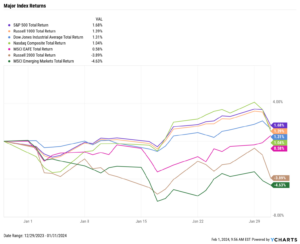
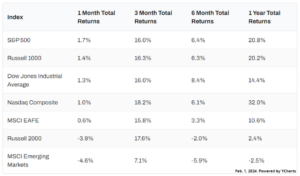
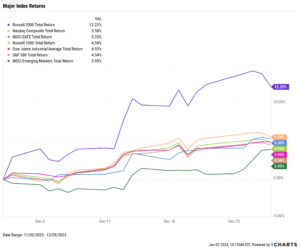
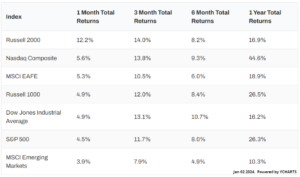
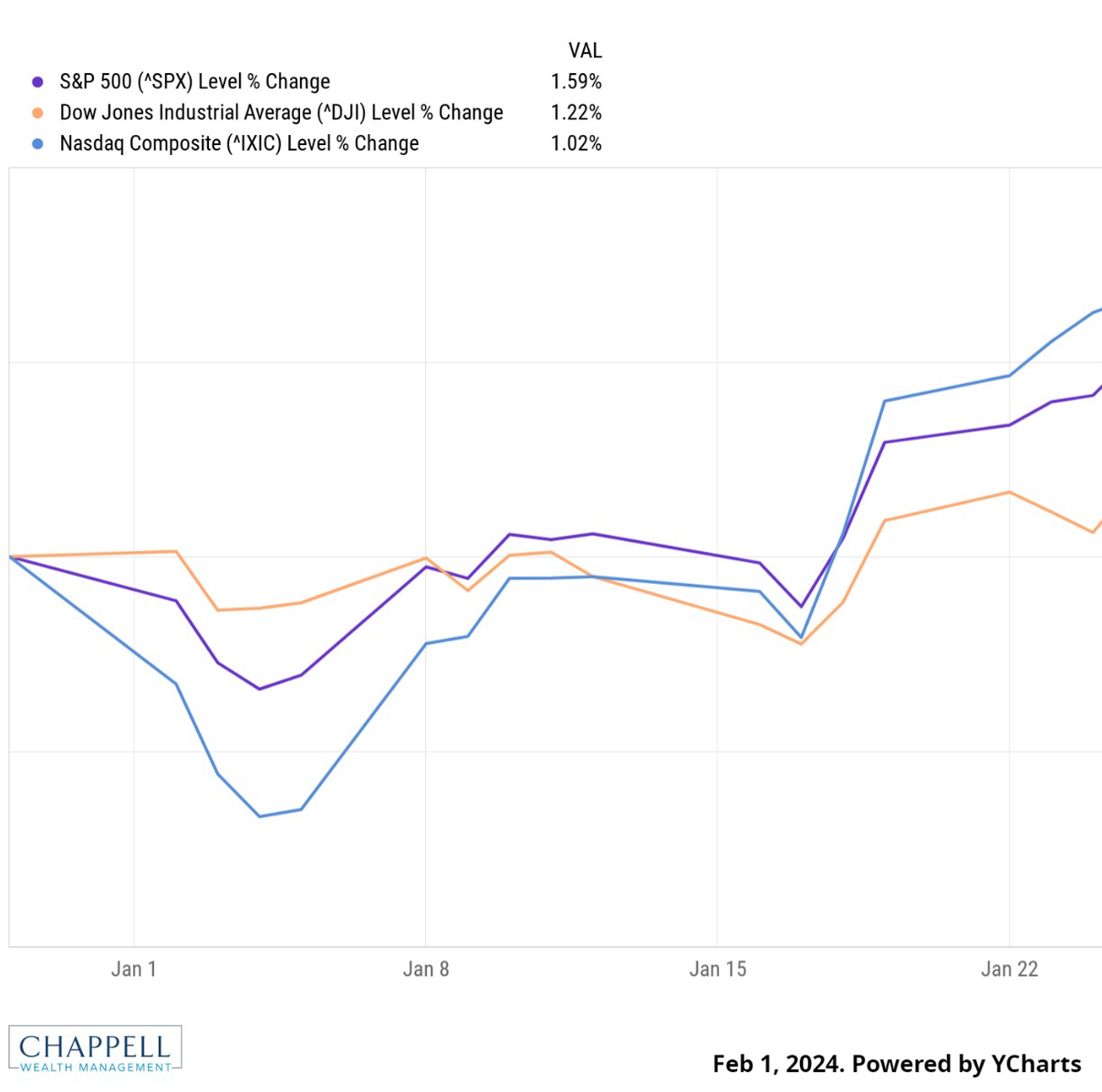
Stocks rallied into the end of the year. The Dow Jones Industrial Average rose 4.9%, the S&P 500 advanced 4.5%, and the NASDAQ jumped 5.6%. Small-caps had a particularly standout month, as the Russell 2000 surged 12.2% in December. For the year, the Dow logged a 16.2% gain, the S&P 500 added 26.3%, and the NASDAQ blazed higher by 44.6%.

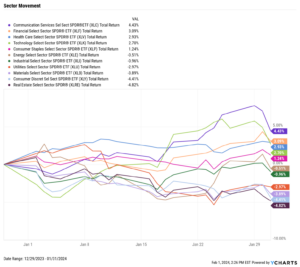
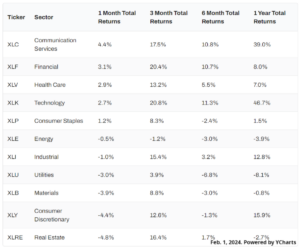
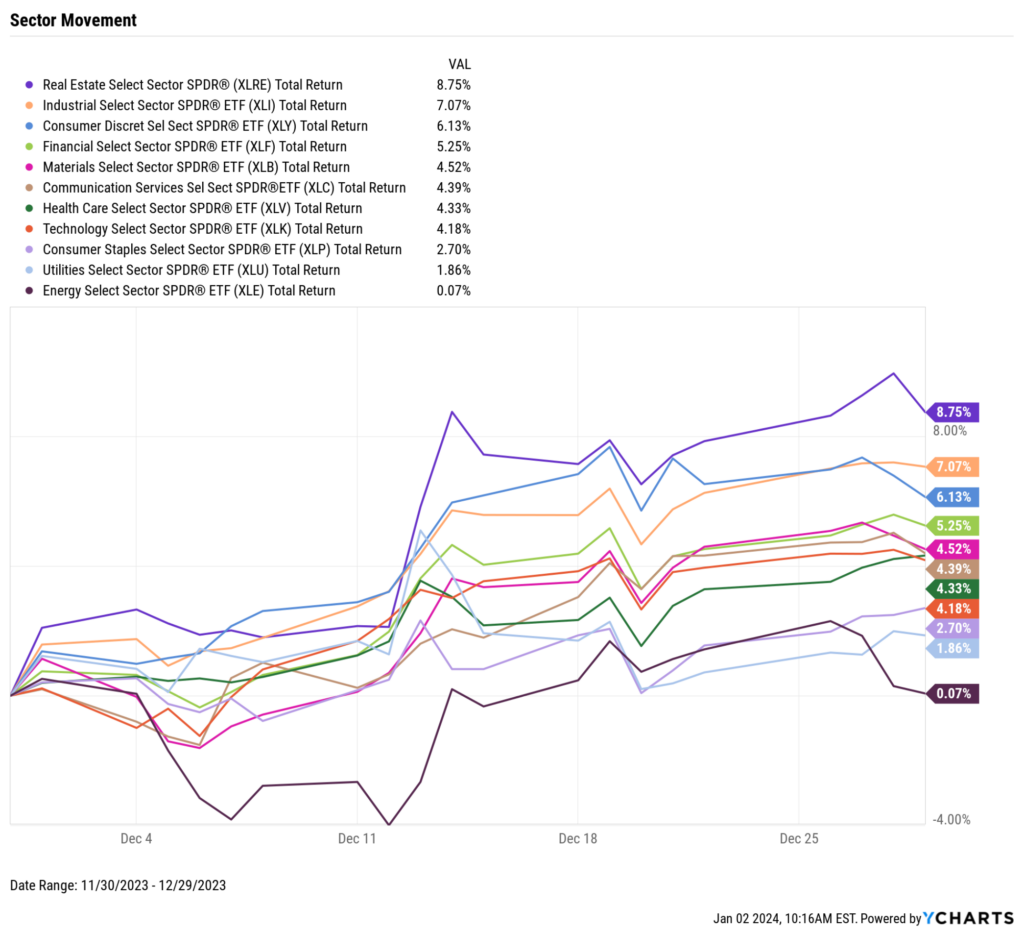
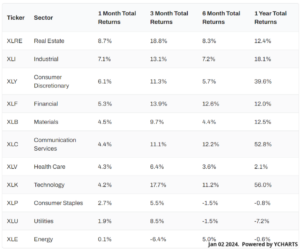
All eleven sectors posted a positive December. Real Estate led the way with an 8.8% increase, followed by a 7.1% advance in Industrials and 6.1% in Consumer Discretionary. Technology, Communication Services, and Consumer Discretionary were the best-performing sectors in 2023, while three sectors recorded a down year: Energy, Consumer Staples, and Utilities.

Mortgage rates retreated lower in December as the 15-year fell below 6% for the first time since May 2023, and the 30-year ended below 7% for the first time since mid-August. The average retail price of gas reached its lowest level of 2023 in December, which was $3.18 per gallon.

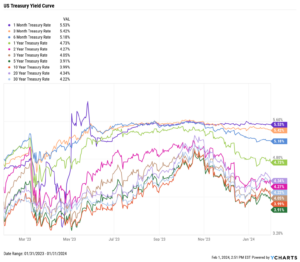
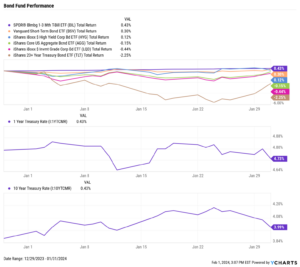
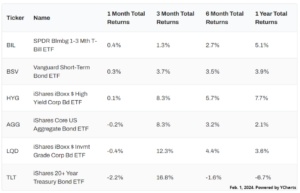
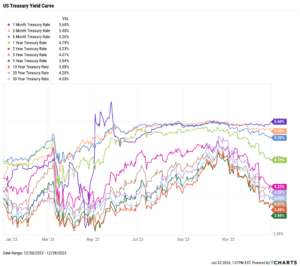
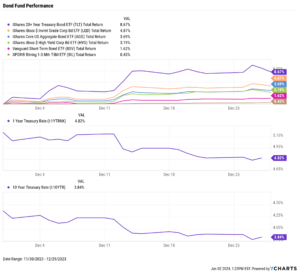
Treasury yields fell further in December as investors continued to pile into equities. Longer-term instruments saw larger declines, as yields on the 20-year and 30-year fell by 52 and 51 basis points, respectively. The 5-year and 10-year both tumbled below 4%. However, bond ETFs experienced price appreciation in December as a result of falling yields; the iShares 20+ Year Treasury Bond ETF (TLT) popped higher by 8.7%, and the iShares Core US Aggregate Bond ETF (AGG) rose 3.7%.


Chappell Wealth Watch! 2023 S&P 500 Winners & Losers

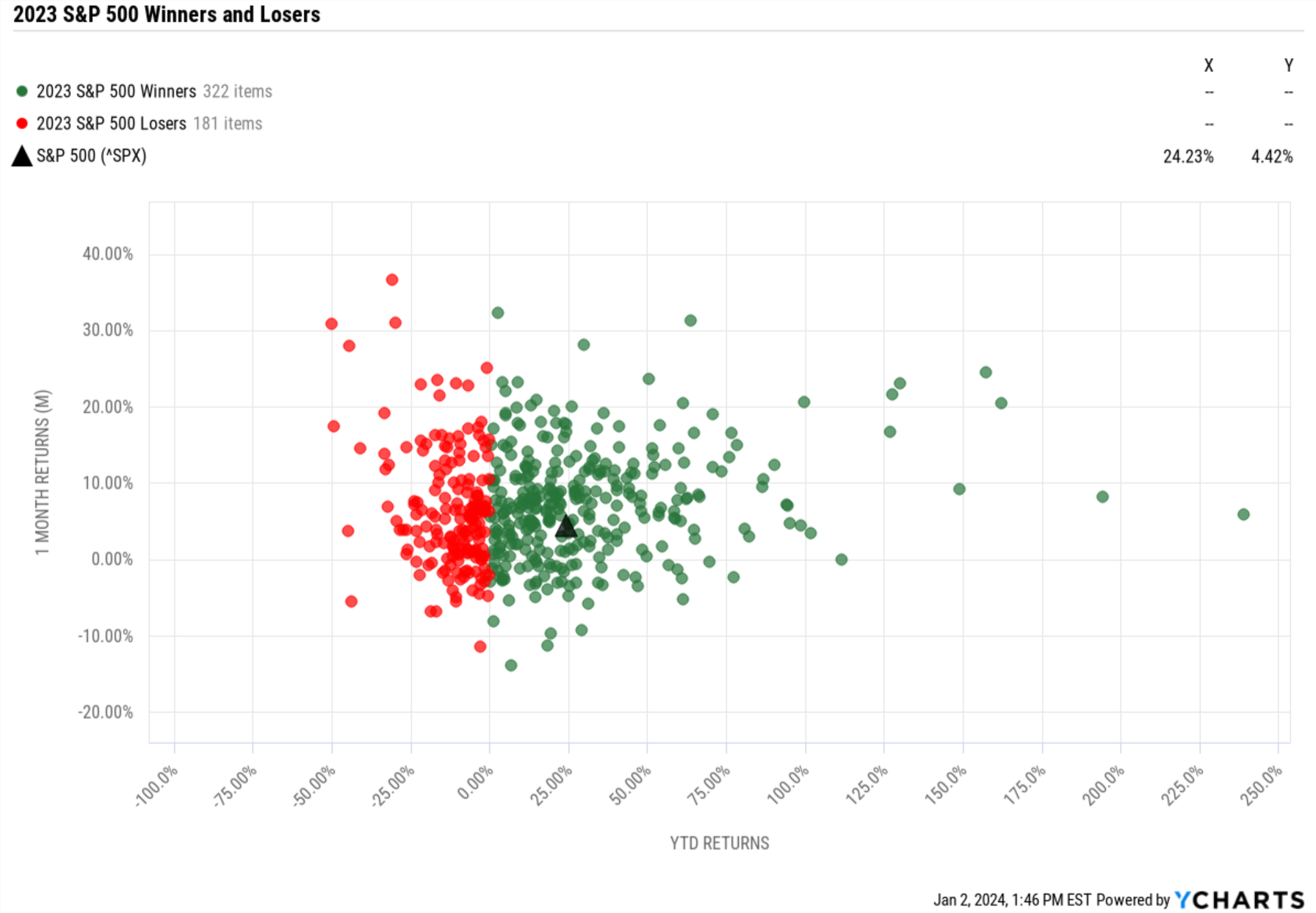
Out of the 503 S&P 500 constituents, 322 of them posted positive returns in 2023. In other words, about two-thirds of the S&P 500 (64%) had a good year.

Who were the best and worst performers in 2023? The best: NVIDIA (NVDA) took the crown with a whopping 238.9% increase. Meta Platforms (META) was a close second at 194.2%, followed by Royal Caribbean Group (RCL), which bounced back 162% in 2023 after slumping 63% between 2020-2022.

The worst performers in 2023: Enphase Energy (ENPH), FMC (FMC), and Dollar General (DG), which ended the year down 50.1%, 49.5%, and 44.8%, respectively.


Equity Performance

Major Indexes


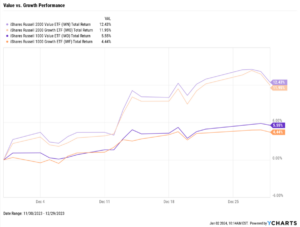
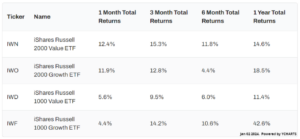
Value vs. Growth Performance


US Sector Movement


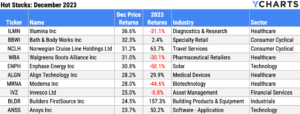
Top 10 S&P 500 Performers


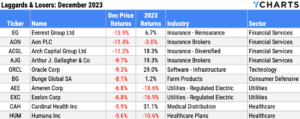
10 Worst S&P 500 Performers


Economic Data

Employment

November’s unemployment rate retreated two-tenths of a percentage point lower to 3.7%, as the labor force participation rate rose to 62.8%. 199,000 jobs were added in November according to nonfarm payroll data, slightly above the expected increase of 190,000.

Consumers and Inflation

The US inflation rate continued its YoY slide, falling to 3.14% in November which is the lowest print in 5 months. Core Inflation slowed to 4.01%, its lowest YoY level since September 2021. The monthly US Consumer Price Index inched 0.1% higher, and monthly US Personal Spending grew a quarter of a percent in the same month. The Federal Reserve held its key Fed Funds Rate at 5.50% at its December 13th, 2023 meeting, marking the Fed’s third consecutive meeting in which rates were left unchanged.

Production and Sales

The US ISM Manufacturing PMI remained unchanged at 46.7 in November and in contraction territory for the 13th consecutive month. November US Retail and Food Services Sales rose 0.28% MoM after contracting for the first month in the last eight, while the YoY US Producer Price Index fell for the second straight month to 0.86%.

Housing

US New Single-Family Home Sales plummeted 12.2% MoM in November while US Existing Home Sales inched 0.8% higher MoM. However, the Median Sales Price of Existing Homes fell for the fifth straight month to $387,600 in November. The median price of existing homes is 6.33% below its all-time high. Mortgage rates continued their cooldown into December; the 15-year Mortgage Rate ended the year at 5.93%, below 6% for the first time since May. The 30-year closed out 2023 at 6.61%, falling below 7% for the first time since mid-August.

Commodities

The price of Gold ended the year at $2,062.28 per ounce, representing a monthly increase of 1.32%. Crude oil prices were largely unchanged MoM despite having encountered some price volatility within December. As of Christmas Day, the price of WTI per barrel was $75.84 while Brent was $80.23. December brought drivers the lowest average price of gas in 2023, which was $3.18 per gallon on December 18th. The last time the average price of gas was that low was June of 2021.


Fixed Income

US Treasury Yield Curve


Bond Fund Performance

November 2023 Monthly Market Update

November 2023 Market Update

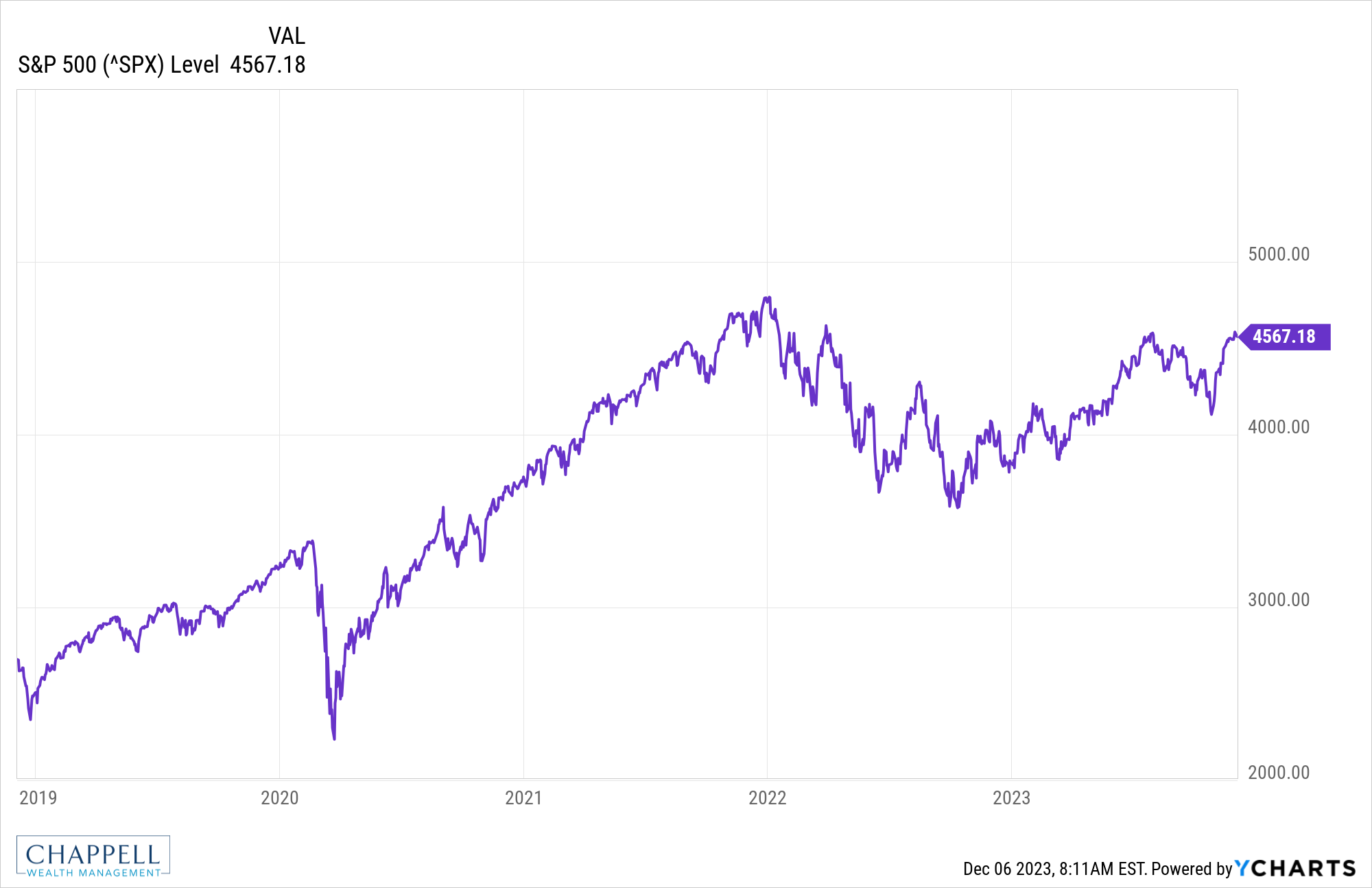
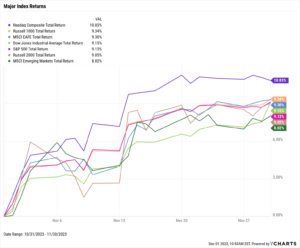
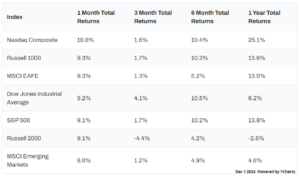
Stocks recorded a highly bullish November as the S&P 500 advanced 9.1%, the Dow Jones Industrial Average charged 9.2% higher, and the NASDAQ surged 10.8%. The Russell 1000 finished November up 9.3%, and the small-cap Russell 2000 added 9.1%. Global indices joined the party as well–Emerging Markets posted an 8.0% gain in November and EAFE jumped 9.3%.

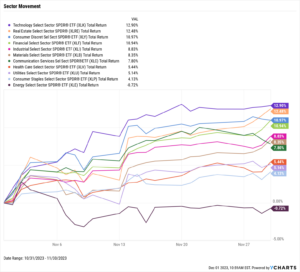
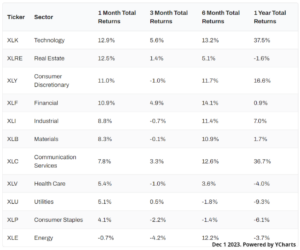
Energy was the month’s sole negative sector, declining 0.7%. The Technology, Real Estate, Consumer Discretionary, and Financial sectors all posted double-digit gains in November.

Existing home sales declined for the fifth straight month while the median price of an existing home fell for the fourth month in a row. However, the 15-year Mortgage Rate backed off of 7%, a level it hadn’t reached since 2000. Both inflation and core inflation decelerated, and CPI was nearly unchanged MoM. The per-ounce price of Gold breached the key $2,000 level in November and is 1.5% off from its all-time high of $2,067.20.

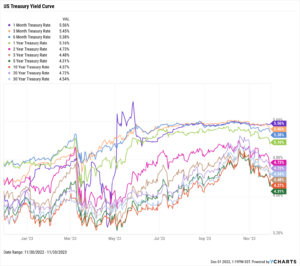
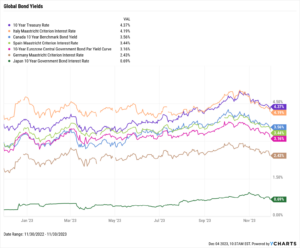
Treasury yields tumbled in November as investors piled back into equities. Yields on the 5-year and 10-year treasuries fell by 51 basis points, the most out of any duration on the curve. The 1-month T-Bill ended November unchanged at 5.56%. Yields on certain global fixed-income instruments also dove lower in November.


Chappell Wealth Watch! November S&P 500 Winners & Losers

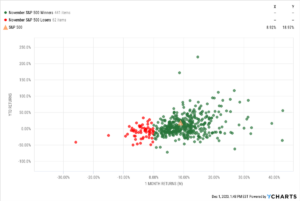
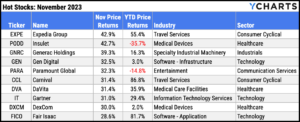
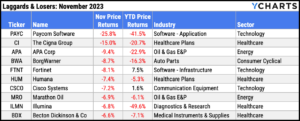
Out of the 503 S&P 500 constituents, 441 of them posted positive returns in November. In other words, 87.7% of the S&P 500 had a positive month.

However, finding an individual stock that outperformed the S&P 500 index’s 8.92% gain in November was a more difficult task. 250 of the 503 constituents posted a return higher than the S&P 500 index’s November gain, giving just about a 50-50 chance of picking a company that would’ve beaten the index.


Equity Performance

Major Indexes


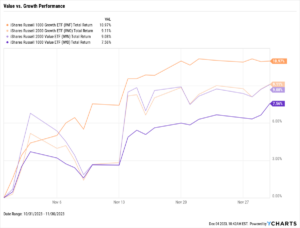
Value vs. Growth Performance
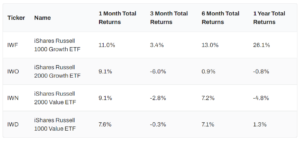
Trailing Twelve Months


US Sector Movement


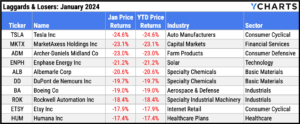
Top 10 S&P 500 Performers


10 Worst S&P 500 Performers


Economic Data

Employment

October’s unemployment rate increased one-tenth of a percentage point to 3.9%, while the labor force participation rate decreased by that same amount to 62.7%. October nonfarm payroll data showed 150,000 jobs added, falling short of the 170,000 expected for the month.

Consumers and Inflation

The US inflation rate decreased to 3.24% in October, down from 3.70% in September. Core Inflation decelerated for the seventh consecutive month, from 4.15% in September to 4.03% in October. The US Consumer Price Index was essentially unchanged MoM, and US Personal Spending grew at a below-average rate of 0.22% MoM.

Production and Sales

The US ISM Manufacturing PMI remained unchanged at 46.7 in November and in contraction territory for the 13th consecutive month. October US Retail and Food Services Sales contracted by 0.1% MoM, while the YoY US Producer Price Index fell eight-tenths of a percentage point in October to 1.34%.

Housing

US New Single-Family Home Sales MoM continued its up-and-down ways in October, contracting by 5.6% after having jumped 8.6% in September. US Existing Home Sales sank 4%, down for the fifth consecutive month and 19th out of the last 21. The Median Sales Price of Existing Homes fell for the fourth straight month, to $391,800 in October. Mortgage rates cooled down in November; the 15-year Mortgage Rate closed out the month at 6.56% after topping 7% for the first time since December 2000, and the 30-year ended November at 7.22%, down 0.79 percentage points since the end of last month.

Commodities

The price of Gold crossed above $2,000 in November to $2,035.50 per ounce as of November 30th. Crude oil went the opposite direction; the price of WTI oil fell 8.8% in November to $74.46 per barrel as of November 27th, while Brent slipped 8.4% to $79.49 per barrel in that same time frame. This helped deliver motorists a second consecutive month of lower prices at the pump, as the average price of regular gas fell 16 cents in November to $3.36 per gallon, its lowest level since the start of 2023.


Fixed Income

US Treasury Yield Curve


Global Bonds

October 2023 Monthly Market Update

October 2023 Market Update

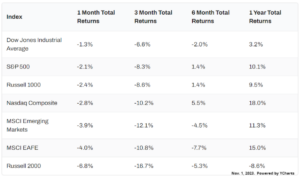
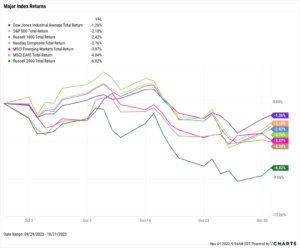
Stocks declined for the third straight month, with the Dow Jones Industrial Average falling 1.3%, the S&P 500 slipping 2.1%, and the NASDAQ giving up 2.8%. Globally, Emerging Markets fell 3.9% and EAFE lost 4.0%. Small and mid-cap stocks were the most adversely affected; the Russell 2000 dove 6.8%, while the large-cap Russell 1000 gave up only 2.4%.

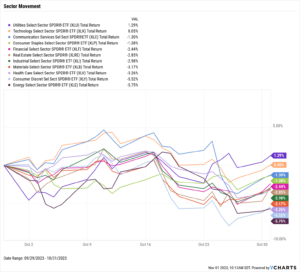
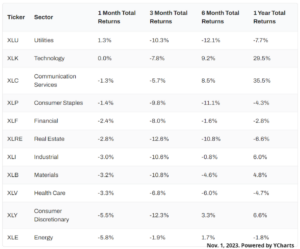
After being the only US stock sector to finish in the black for the last two months, Energy was the biggest laggard in October, with a 5.8% decline. Only Utilities and Technology advanced higher in October, up 1.3% and 0.1%, respectively.

Mortgage rates continued to shoot higher as the 15-year Mortgage Rate breached 7% for the first time since 2000, while the 30-year Mortgage Rate approached 8%. Housing prices took a hit as a result; the Median Sales Price of Existing Homes fell for the third straight month and was below $400,000 for the first time since May. The Inflation rate essentially remained the same between September and October, though Core Inflation slightly decreased. Oil prices sank in October, helping to lower the average price of regular gas by 36 cents to $3.60 per gallon.

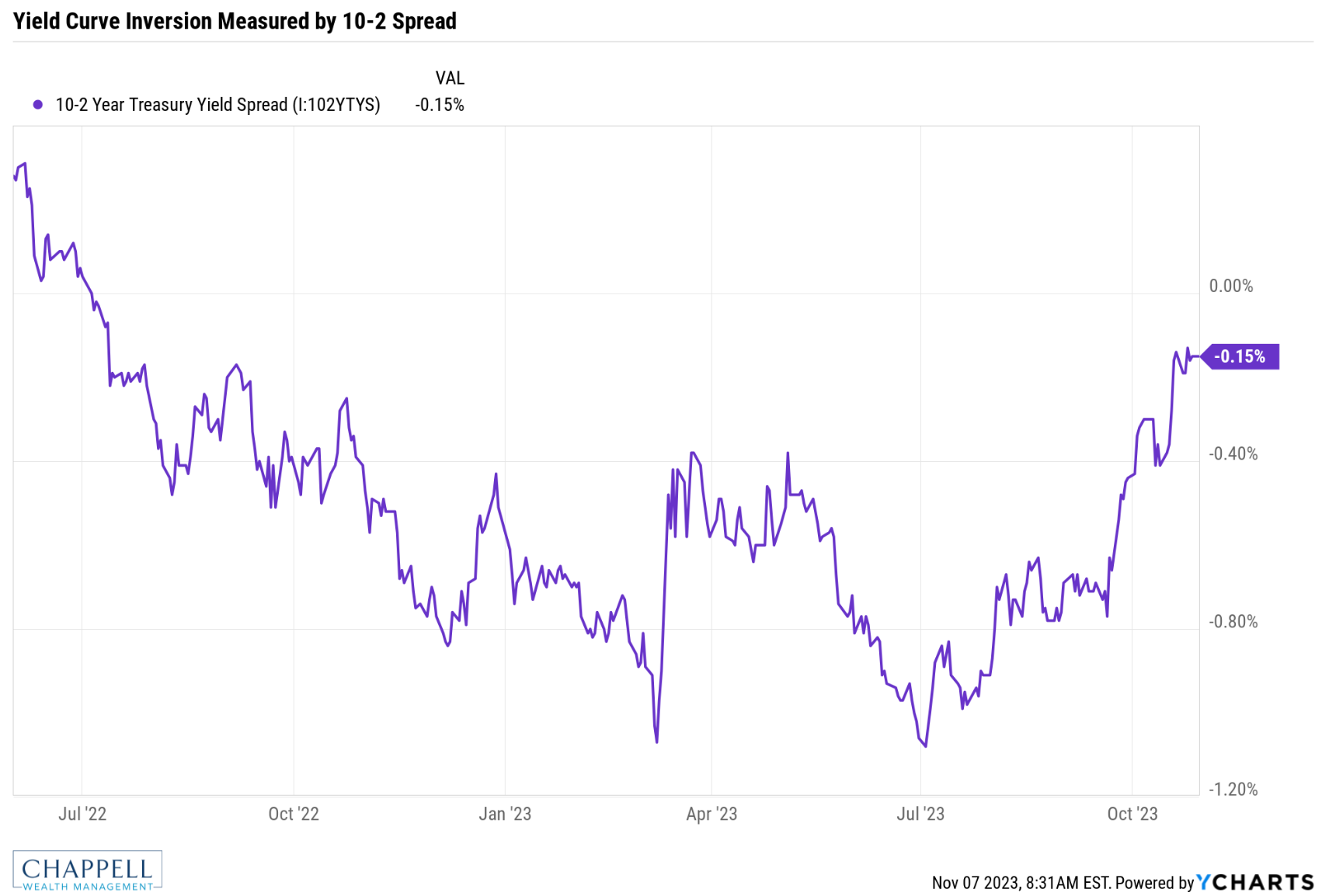
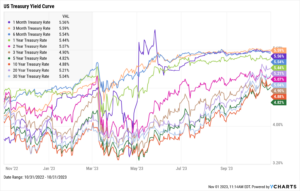
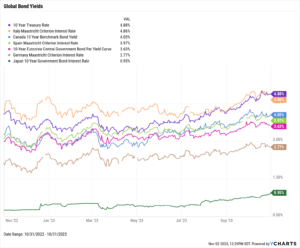
The yield curve trended toward normalcy in October. Yields on the 3-year, 5-year, 10-year, 20-year, and 30-year treasuries all increased by double-digits, with the 30-year logging the largest rise of 31 basis points. The 20-year and 30-year both eclipsed 5% for the first time since July 2007, ending the month at 5.21% and 5.04%, respectively. Italy’s Long Term Bond Interest Rate was overtaken by the US 10-year, and Japan’s 10 Year Government Bond Interest Rate neared 1% in October.


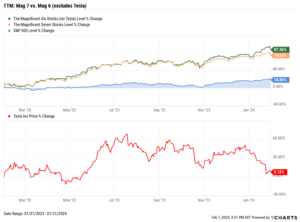
Chappell Wealth Watch! 2023 – A Year of Mega Caps

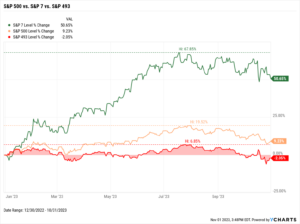
Just how important are the so-called “Magnificent Seven” stocks to the overall market this year?

If you invested in just the “S&P 7”– Apple (AAPL), Amazon (AMZN), Alphabet (GOOG, GOOGL), Meta Platforms (META), Microsoft (MSFT), NVIDIA (NVDA), and Tesla (TSLA) – on a market cap-weighted basis at the start of the year, you would have enjoyed a 50.7% return YTD.

Take those seven names out of the S&P 500, however, and the index is negative YTD.

It’s safe to say that the S&P 7 stocks have certainly played a prominent role in bringing the overall S&P 500 index up 9.2% YTD. The “Magnificent Seven” constitute roughly 29% of the S&P 500, making the index the most concentrated it has been in over 25 years.


Equity Performance
Major Indexes


Value vs. Growth Performance
Trailing Twelve Months


US Sector Movement


Top 10 S&P 500 Performers


10 Worst S&P 500 Performers


Economic Data

Employment

September’s unemployment rate was unchanged at 3.8%, as was the labor force participation rate at 62.8%. However, September nonfarm payroll data showed 336,000 jobs added, the most in the last eight months and handily surpassing expectations of 159,000.

Consumers and Inflation

At 3.70%, the US inflation rate for September was essentially unchanged from August’s 3.67% level. Core Inflation decreased for the sixth straight month, down from 4.35% in August to 4.15% in September. The US Consumer Price Index MoM rose 0.40% in September, while US Personal Spending MoM accelerated 0.74%. The Federal Reserve kept the benchmark Target Federal Funds Rate unchanged at 5.50% for the second consecutive FOMC meeting, which took place on November 1st.

Production and Sales

The US ISM Manufacturing PMI dove by 2.3 points in October to 46.7, breaking a streak of three consecutive monthly increases and returning to contraction territory. US Retail and Food Services Sales MoM grew by 0.71% in September, and the YoY US Producer Price Index rose by two-tenths of a percentage point to 2.17%.

Housing

US New Single-Family Home Sales MoM rebounded by 12.3% in September following an 8.2% contraction in August. September marked the largest MoM increase for new single-family homes since August 2022. US Existing Home Sales were down 2%, sinking for the fourth consecutive month and 18th out of the last 20. The Median Sales Price of Existing Homes fell below $400,000 for the first time since May to $394,300. September also marked the third consecutive month in which median prices for existing homes fell. Mortgage rates again reached new highs in October; the 15-year Mortgage Rate topped 7% for the first time since December 2000, and the 30-year ended the month at 7.79%.

Commodities

The price of Gold rebounded 6% in October, from $1,870.50 to $1,982.90. After breaching $90 per barrel in September, the price of WTI oil reversed course in October and ended the month at $83.03 per barrel, a decline of 8.5%. The price of Brent fell 5.35% to $90.73 per barrel but stayed above that key $90 level. Lower oil prices helped deliver drivers some relief at the pump, as the average price of regular gas fell 36 cents in October to end the month at $3.60 per gallon, its lowest level since March.


Fixed Income

US Treasury Yield Curve


Global Bonds